Social Media Outreach Tips is one of the most effective ways for businesses, freelancers, creators, and marketers to build relationships, generate leads, and create new opportunities. However, sending the same generic message to everyone rarely produces good results.
If your outreach messages are being ignored, the problem may not be your offer—it could be how you approach the person, personalize the message, and create a reason for them to respond.
In this guide, we’ll explore practical social media outreach tips that can help you get more replies and build meaningful professional connections.
What Is Social Media Outreach?
Social Media Outreach Tips is the process of contacting potential customers, clients, influencers, creators, business owners, or industry professionals through platforms such as Instagram, LinkedIn, Facebook, and X.
The goal can vary depending on your business:
- Generate leads
- Promote a product or service
- Build partnerships
- Connect with influencers
- Find potential clients
- Promote content
- Build brand awareness
- Start professional conversations
Successful outreach is not about sending the maximum number of messages. It is about starting the right conversations with the right people.
Why Do Social Media Outreach Messages Get Ignored?
Before improving your outreach strategy, understand why people don’t respond.
Common reasons include:
Generic Messages
Messages such as:
“Hi, we provide digital marketing services. Are you interested?”
give the recipient little reason to reply.
No Personalization
If your message looks like it was copied and sent to hundreds of people, it is easy to ignore.
Too Much Information
A long paragraph explaining your entire company, services, pricing, and benefits can overwhelm the recipient.
Asking for Something Immediately
Asking for a meeting, purchase, collaboration, or payment in the first message can feel too aggressive.
Targeting the Wrong Audience
Even an excellent message will not generate replies if you’re contacting people who don’t need your product or service.
Social Media Outreach Tips to Get More Replies
1. Research Before You Reach Out
Social Media Outreach Tips Don’t send your message immediately after finding someone’s profile.
Spend a few minutes understanding:
- Who they are
- What they do
- Their business
- Their recent posts
- Their interests
- Their challenges
- Their current projects
For example, if you’re reaching out to a business owner, check whether they recently launched a product, redesigned their website, or posted about a business challenge.
This gives you a natural conversation starter.
2. Personalize Every Message
Personalization is one of the most important social media outreach tips.
Instead of:
“Hi, we help businesses grow online.”
Try:
“Hi Miruthika Enterprises, I came across your recent post about expanding your online presence. I really liked your point about customer engagement.”
The second message feels more genuine because it demonstrates that you’ve actually looked at their content.
What Can You Personalize?
You can personalize:
- Their name
- Business name
- Recent post
- Product
- Industry
- Achievement
- Shared interest
- Recent announcement
You don’t need to write a completely different message every time. A good outreach template can be customized with relevant details.
3. Start With Conversation, Not a Sales Pitch
One of the biggest outreach mistakes is trying to sell immediately.
Instead, start a conversation.
For example:
Instead of:
“Would you like to purchase our SEO package?”
Try:
“I noticed you’re publishing more content recently. Are you currently handling SEO in-house?”
This creates an opportunity for the person to respond without feeling pressured.
Once the conversation develops, you can introduce your service naturally.
4. Keep Your First Message Short
Your first outreach message should be easy to read and easy to answer.
A simple structure is:
Personal observation + Relevant question + Soft CTA
Example:
“Hi [Name], I noticed your company has recently started posting more consistently on LinkedIn. Are you currently managing the content internally?”
This is much easier to respond to than a long sales presentation.
5. Give a Clear Reason for Contacting Them
People should understand why you’re messaging them.
Avoid vague statements such as:
“I wanted to connect with you.”
Instead, explain the reason:
“I noticed your website is getting more content published, and I had a quick idea that could help improve its organic visibility.”
A clear reason makes your message more relevant.
6. Engage With Their Content Before Messaging
If possible, interact with the person’s content before sending a direct message.
You can:
- Like their post
- Leave a meaningful comment
- Share useful information
- Respond to their story
- Participate in their discussion
Don’t leave generic comments such as:
“Nice post!”
Instead, add something relevant to the conversation.
This can make your eventual DM feel more natural.
7. Ask Simple Questions
A complicated question can reduce the chance of getting a reply.
Compare:
“Would you be available for a 30-minute meeting next Tuesday to discuss how our comprehensive marketing solutions can transform your customer acquisition strategy?”
with:
“Are you currently working on improving your lead generation?”
The second question requires much less effort to answer.
Good Outreach Questions
Try questions such as:
- “Are you currently handling this in-house?”
- “Are you planning to expand this service?”
- “Have you tried this strategy before?”
- “Would you be open to a quick idea?”
- “Is improving your online visibility a priority right now?”
8. Provide Value Before Asking for Something
One of the strongest ways to improve response rates is to give value first.
For example, if you’re a digital marketer, you could point out:
- A broken link
- An SEO opportunity
- A content gap
- A website usability issue
- A social media improvement
- A missed keyword opportunity
Instead of saying:
“We offer SEO services.”
You could say:
“I noticed three pages on your website that aren’t targeting location-based keywords. I thought you might find that useful.”
Now the conversation begins with value rather than a sales pitch.
9. Use a Soft Call to Action
Your CTA should make replying easy.
Instead of:
“Book a meeting with us today.”
Try:
“Would you like me to share the quick audit?”
Or:
“Would you be interested in seeing the idea?”
A soft CTA reduces pressure and encourages conversation.
10. Choose the Right Platform
Different social media platforms work better for different audiences.
Best for:
- B2B outreach
- Professional networking
- Recruitment
- Business partnerships
- SaaS and technology services
Best for:
- Creators
- Local businesses
- E-commerce
- Fitness
- Fashion
- Lifestyle brands
Useful for:
- Local communities
- Groups
- Small businesses
- Community-based services
X
Useful for:
- Industry conversations
- Technology
- Startups
- Creators
- Real-time discussions
Choose the platform where your target audience is already active.
11. Follow Up Without Being Pushy
Not receiving a response doesn’t always mean the person isn’t interested. They may simply be busy.
A polite follow-up can bring your message back to their attention.
First Follow-Up
“Hi [Name], just following up on my previous message. I had a quick idea that may be useful for your business. Happy to share it if you’re interested.”
Second Follow-Up
“No worries if this isn’t a priority right now. If you’d like, I can send over the idea for you to review whenever convenient.”
Avoid sending multiple messages every day.
12. Use Social Listening
Social listening can help you identify people who are already discussing problems your business can solve.
Monitor:
- Industry keywords
- Product discussions
- Customer complaints
- Competitor mentions
- Trending topics
- Questions
- Business challenges
For example, if someone posts:
“We’re struggling to generate leads through our website.”
and you provide lead-generation services, that could be a much stronger outreach opportunity than randomly messaging hundreds of businesses.
13. Build Relationships Instead of Chasing Leads
The best social media outreach strategy focuses on relationships.
Not every person you contact will become a customer immediately.
Some may become:
- Future customers
- Referral partners
- Collaborators
- Industry connections
- Brand advocates
- Long-term contacts
Think beyond the immediate sale.
14. Make Your Profile Trustworthy
People often check your profile before replying.
Your profile should clearly communicate:
- Who you are
- What you do
- Who you help
- Your expertise
- Your company or brand
- Examples of your work
A professional profile increases credibility and makes your outreach feel more legitimate.
15. Track Your Outreach Results
Don’t rely only on how many messages you send.
Track important metrics such as:
| Metric | What It Tells You |
|---|---|
| Messages Sent | Outreach volume |
| Replies | Conversation rate |
| Positive Replies | Lead quality |
| Meetings | Conversion potential |
| Leads | Business opportunities |
| Conversions | Actual results |
If 100 messages generate only two replies, don’t simply send 500 more.
Instead, review:
- Target audience
- Message quality
- Personalization
- Offer
- CTA
- Timing
Then improve your approach.
16. Test Different Message Styles
There isn’t one perfect outreach message for every business.
Test different approaches.
Version A – Question-Based
“Are you currently working on improving your website traffic?”
Version B – Observation-Based
“I noticed your latest blog posts aren’t targeting location-specific search terms.”
Version C – Value-Based
“I spotted a couple of quick SEO opportunities on your website. Would you like me to share them?”
Track which approach generates the best conversations.
17. Avoid Spammy Outreach Practices
Good outreach should always respect the recipient.
Avoid:
- Sending the same message repeatedly
- Buying contact lists
- Misleading subject lines
- Fake personalization
- Excessive follow-ups
- Aggressive sales tactics
- Automated spam
- Pretending to know someone
- Making unrealistic promises
Respect people’s time and platform rules.
A Simple Social Media Outreach Formula
A practical formula you can remember is:
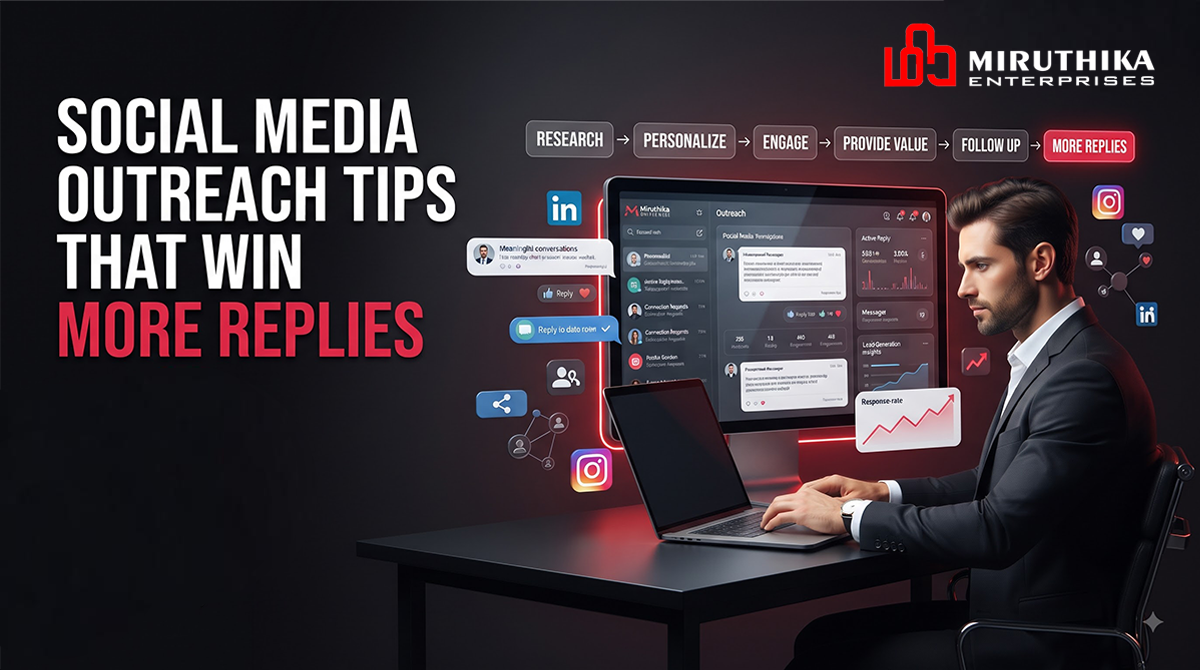
Research → Personalize → Start Conversation → Provide Value → Ask → Follow Up → Build Relationship
This approach is more sustainable than mass messaging.
Example Social Media Outreach Message
Here’s a simple example for a digital marketing service:
Hi Miruthika Enterprises, I came across your business page and noticed you’re actively posting about Digital Marketing. I had a quick idea that could help improve your online visibility. Would you like me to share it?
It’s short, personalized and gives the recipient a simple reason to respond.
How to Improve Your Reply Rate
If you’re consistently getting low response rates, review these five areas:
Targeting
Are you contacting people who actually need your service?
Personalization
Does your message demonstrate that you’ve researched them?
Value
Are you offering something useful?
CTA
Is your question simple to answer?
Timing
Are you reaching out when your audience is active?
Small improvements in each area can significantly improve the quality of your conversations.
Final Thoughts
Effective social media outreach isn’t about sending thousands of messages. It’s about finding the right people, understanding their needs, starting genuine conversations and providing value.
Keep your messages short, personalize your approach, ask simple questions and follow up respectfully. Most importantly, focus on building relationships instead of treating every conversation as an immediate sales opportunity.
With consistent testing and tracking, you can develop an outreach strategy that generates more replies, stronger connections and better business opportunities.
About the Author