
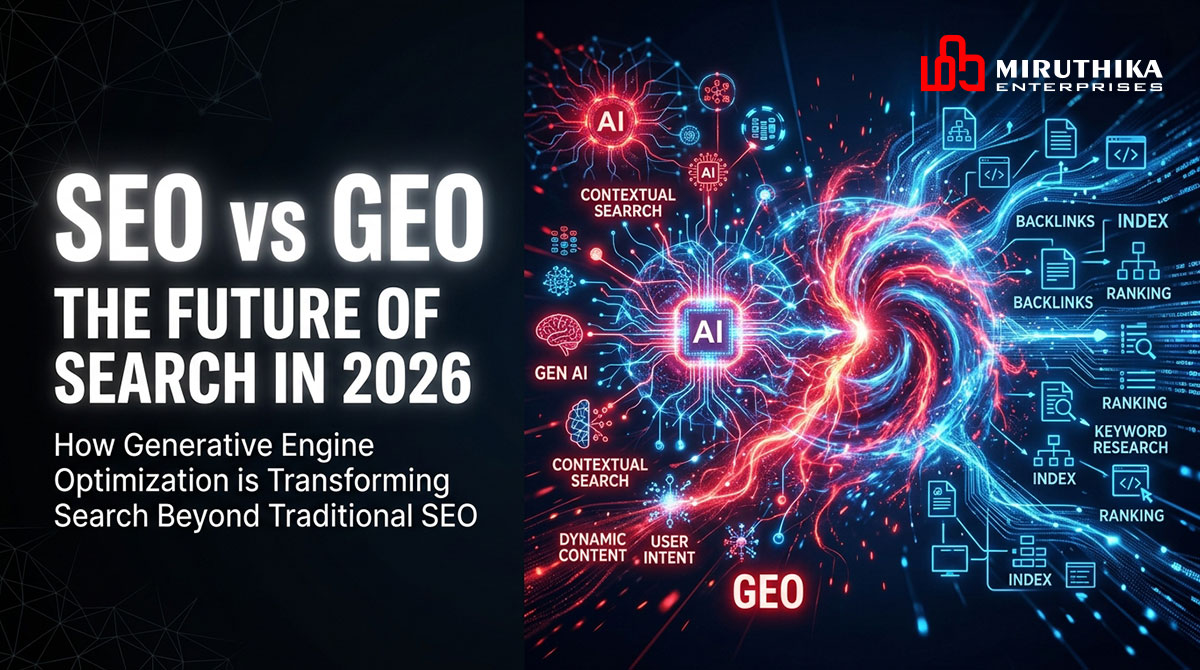
Search engine optimization has changed dramatically over the last few years. Traditional SEO techniques that once focused only on ranking websites in Google’s blue links are no longer enough. With the rise of AI-powered search engines and conversational tools like ChatGPT, Google AI Overviews, and Gemini, businesses now need a new strategy called GEO — Generative Engine Optimization.
In 2026, digital marketing is no longer just about ranking on search engines. It is about becoming the trusted source that AI systems choose when generating answers for users. This shift is transforming the future of online visibility, website traffic, and digital branding.
In this blog, we will explore the complete difference between SEO and GEO, how AI search works, why GEO matters, and how businesses can optimize their websites for the future of search.
What Is SEO?
SEO (Search Engine Optimization) is the process of improving a website’s visibility in search engine results pages (SERPs). The main goal of SEO is to rank higher on search engines like Google and attract organic traffic.
SEO typically includes:
- Keyword optimization
- Technical SEO
- On-page optimization
- Backlink building
- Content creation
- Mobile optimization
- Page speed improvement
- Internal linking
- User experience enhancement
For years, SEO has been the foundation of digital marketing. Businesses used SEO strategies to improve rankings for specific keywords and increase website visitors.
For example:
- “Best digital marketing agency in Chennai”
- “Women-only fitness studio near me”
- “Affordable website design services”
Traditional SEO focuses on ranking webpages in search results when users type queries into search engines.
What Is GEO (Generative Engine Optimization)?
GEO stands for Generative Engine Optimization. It is the process of optimizing content so that AI-powered search engines and generative AI systems use your content when generating answers.
Unlike traditional search engines that display a list of links, generative engines provide direct AI-generated responses. These AI systems collect information from multiple trusted sources and summarize answers for users instantly.
Examples of generative search platforms include:
- ChatGPT
- Perplexity AI
- Google Gemini
- Microsoft Copilot
- Google AI Overviews
Instead of only ranking on page one, GEO helps your brand become part of AI-generated answers.
For example:
If a user asks:
“What are the best SEO strategies for small businesses in 2026?”
An AI engine may summarize information from multiple trusted websites and provide a direct answer without the user clicking multiple links.
If your content is optimized for GEO, your business has a better chance of being included in that AI-generated response.
SEO vs GEO: Major Differences
| Feature | SEO | GEO |
|---|---|---|
| Main Goal | Rank webpages | Become AI answer source |
| Platform | Search engines | AI generative engines |
| Focus | Keywords & rankings | Context & authority |
| Search Result | Blue links | AI-generated answers |
| Traffic Source | Organic clicks | AI references & visibility |
| Optimization | Technical SEO | Semantic relevance |
| User Behavior | Click & browse | Ask & receive answers |
| Content Style | Keyword-focused | Conversational & informative |
| Ranking Factor | Backlinks, SEO signals | Trust, expertise, context |
| Future Potential | Still important | Rapidly growing |
Why GEO Is Becoming Important in 2026
The way people search online is changing rapidly.
Instead of typing short keywords like:
Users now ask conversational questions like:
- “Which SEO company is best for small businesses in Chennai?”
AI search engines understand natural language and provide instant summarized answers.
This shift is reducing traditional click-through rates because users often get answers directly without visiting websites.
This trend is known as “zero-click search.”
Businesses that fail to adapt may lose visibility even if they rank on Google.
That is why GEO is becoming essential for modern digital marketing.
How AI Search Engines Work
Generative AI systems analyze massive amounts of online content and identify trustworthy, high-quality information.
These systems evaluate:
- Content quality
- Authority
- Relevance
- Expertise
- Website trust
- User engagement
- Structured data
- Semantic meaning
- Freshness of content
AI engines prefer content that:
- Clearly answers questions
- Uses conversational language
- Provides accurate information
- Demonstrates expertise
- Includes structured formatting
- Has strong topical authority
This means businesses must create high-quality educational content instead of simply stuffing keywords.
Why Traditional SEO Alone Is Not Enough
Traditional SEO still matters, but it is no longer sufficient by itself.
In the past:
- Ranking #1 on Google guaranteed traffic.
Today:
- AI search may answer the query before users click any link.
This means businesses need:
- SEO for search visibility
- GEO for AI visibility
The future belongs to brands that combine both strategies effectively.
Key Elements of GEO Optimization
1. Create Conversational Content
AI systems prioritize natural, human-friendly content.
Instead of writing:
“Best SEO services Chennai affordable company.”
Write:
“If you are looking for affordable SEO services in Chennai, choosing an agency with proven experience and transparent strategies is important.”
Conversational content improves readability and AI understanding.
2. Focus on Topical Authority
AI engines trust websites that deeply cover a subject.
Instead of publishing random articles, create topic clusters such as:
- SEO guides
- AI marketing
- Local SEO
- Content marketing
- Google Ads
- Website optimization
The more authority your website has on a topic, the more likely AI systems will trust your content.
3. Use Question-Based Content
AI search is heavily question-driven.
Add sections like:
- What is GEO?
- Why is GEO important?
- How does AI search work?
- What is the difference between SEO and GEO?
Question-based content improves visibility in AI-generated responses.
4. Improve E-E-A-T Signals
Google emphasizes:
- Experience
- Expertise
- Authoritativeness
- Trustworthiness
Strong E-E-A-T signals help both SEO and GEO.
Ways to improve E-E-A-T:
- Publish expert-level content
- Add author information
- Include case studies
- Show testimonials
- Maintain accurate information
- Earn quality backlinks
5. Optimize for Semantic Search
AI understands meaning, not just keywords.
Instead of repeating:
“SEO services Chennai”
Use related phrases:
- Digital marketing solutions
- Search engine optimization
- Organic traffic growth
- Google ranking strategies
- Local SEO services
Semantic optimization helps AI understand your content contextually.
6. Structure Content Properly
Well-structured content is easier for AI systems to analyze.
Use:
- H1, H2, H3 headings
- Bullet points
- Tables
- FAQs
- Short paragraphs
- Clear formatting
Readable content improves both user experience and AI indexing.
7. Keep Content Updated
AI systems prefer fresh and updated information.
Update blogs regularly with:
- Latest trends
- New statistics
- Industry changes
- Algorithm updates
- AI search developments
Fresh content signals relevance and reliability.
Benefits of GEO for Businesses
Increased AI Visibility
Your business can appear in AI-generated answers across multiple platforms.
Better Brand Authority
AI systems favor trusted brands and expert content creators.
Future-Proof Digital Marketing
GEO prepares businesses for the future of search behavior.
Higher Trust Levels
Being referenced by AI engines increases credibility.
More Qualified Traffic
Users who discover your content through AI-generated answers often have higher intent and engagement.
SEO and GEO Should Work Together
Some people think GEO will replace SEO completely.
That is not true.
SEO and GEO should work together.
SEO helps:
- Improve rankings
- Drive website traffic
- Optimize technical performance
GEO helps:
- Increase AI visibility
- Build authority
- Improve AI discoverability
The most successful digital marketing strategy in 2026 combines both SEO and GEO.
Best GEO Strategies for 2026
Publish Long-Form Educational Content
Detailed guides perform better in AI search because they provide comprehensive information.
Aim for:
- 1500–3000 word blogs
- Deep topical coverage
- Valuable insights
- Practical examples
Add FAQ Sections
FAQ content helps AI extract direct answers easily.
Example:
What is Generative Engine Optimization?
Generative Engine Optimization is the process of optimizing content for AI-powered search engines that generate direct answers for users.
Build Brand Mentions
AI systems notice strong online presence.
Increase:
- Social media mentions
- Online reviews
- PR coverage
- Brand citations
- Backlinks
Use Structured Data
Schema markup helps AI understand your website content better.
Important schema types:
- FAQ schema
- Article schema
- Local business schema
- Review schema
Improve Website Experience
Fast, mobile-friendly websites remain critical.
Optimize:
- Page speed
- Mobile responsiveness
- Navigation
- User engagement
Common GEO Mistakes to Avoid
Keyword Stuffing
AI systems prioritize natural language, not repetitive keywords.
Thin Content
Short, low-value articles perform poorly in AI search.
Ignoring User Intent
Content should solve real user problems.
Publishing Duplicate Content
Originality is essential for both SEO and GEO.
Lack of Expertise
AI systems prefer trustworthy expert-level content.
Future of SEO and GEO
The future of digital marketing will revolve around:
- AI search
- Conversational search
- Voice search
- Personalized AI assistants
- Predictive search experiences
Businesses that adapt early will gain a major competitive advantage.
SEO is evolving — not disappearing.
The next generation of optimization focuses on:
- Authority
- Trust
- Context
- User experience
- AI readability
How Businesses Can Prepare for GEO
To stay competitive in 2026:
- Invest in high-quality content
- Build topical authority
- Focus on user intent
- Optimize for AI readability
- Use structured formatting
- Improve website trust signals
- Publish consistent educational content
The businesses that educate users best will dominate both search engines and AI-powered platforms.
Final Thoughts
SEO and GEO are shaping the future of digital marketing together.
Traditional SEO remains essential for ranking websites and driving traffic. However, Generative Engine Optimization is becoming equally important as AI-powered search continues to grow.
Businesses that understand how AI search works and optimize their content accordingly will achieve stronger online visibility, higher authority, and long-term digital success.
The future is no longer just about ranking on Google.
It is about becoming the trusted source that AI engines choose when generating answers.
Companies that combine SEO and GEO strategies today will lead the digital landscape tomorrow.
About the Author