The Power of Artificial Intelligence – How AI Is Changing the Future of Technology
Introduction
Artificial Intelligence (AI) is one of the fastest-growing technologies in the world. It is changing how people work, communicate, learn and manage businesses. From smart assistants and chatbots to automated systems and AI-generated images, artificial intelligence has become part of our everyday lives.
Today, businesses are using AI to improve productivity, reduce manual work, understand customer behaviour and make better decisions. But have you ever wondered how AI actually works and how machines can understand human instructions?
Let’s explore how artificial intelligence works, its major technologies, applications, benefits and future developments.
1. What Is Artificial Intelligence?
Artificial Intelligence is a branch of computer science that enables machines and computer systems to perform tasks that normally require human intelligence.
These tasks include learning, problem-solving, understanding language, recognizing images, analysing information and making predictions.
For example, when you ask an AI chatbot a question, it processes your input and generates a response based on patterns it has learned during training.
AI is widely used in smartphones, websites, healthcare systems, online shopping platforms, manufacturing industries and digital marketing.
2. How Does Artificial Intelligence Work?
Artificial Intelligence works through a combination of data, algorithms, machine learning models and computing power.
The process generally involves four important stages:
Step 1: Data Collection
AI systems collect information from different sources, including text, images, videos, audio and databases.
Step 2: Data Processing
The collected information is organized and analysed so that the AI model can identify useful patterns.
Step 3: Machine Learning
AI learns from the available data using algorithms and improves its ability to recognize patterns and generate predictions.
Step 4: Output Generation
After processing the input, AI generates an output such as an answer, recommendation, image, prediction or automated action.
This process allows AI systems to perform different tasks quickly and efficiently.
3. Different Types of AI Technologies
Visual Perception with Deep Learning | by Samruddhi Pate | Medium
Meta AI Image Generator Alternative | Dreamina AI Image Generator
Conversational AI in sales: A comprehensive guide for 2025
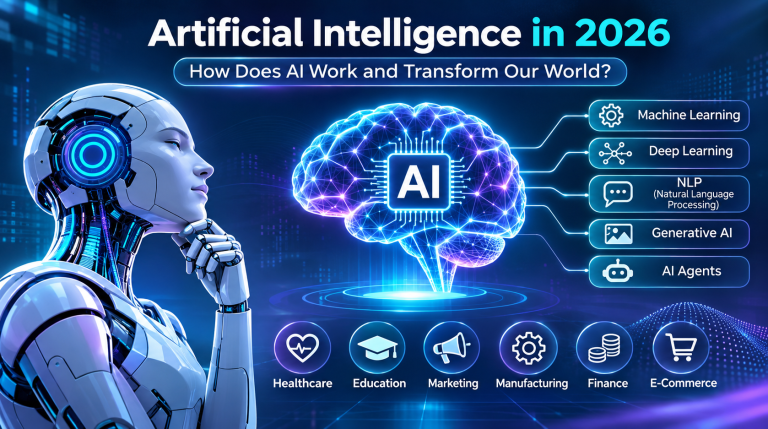
Artificial Intelligence includes several technologies that support different applications.
Machine Learning (ML): Enables systems to learn patterns from data and make predictions without manually programming every instruction.
Deep Learning: Uses artificial neural networks to process complex information such as images, speech and large datasets.
Natural Language Processing (NLP): Helps computers understand, interpret and generate human language.
Generative AI: Creates new content, including text, images, videos, presentations and computer code.
AI Agents: Can plan and perform multiple steps using connected tools to achieve a specific goal.
These technologies work together to make modern AI systems more capable and useful.
4. How Is AI Used in Everyday Life?
Vertical AI Agents: Industry-Specific AI That Goes Beyond ChatGPT
Artificial Intelligence is becoming an important part of many industries.
- Healthcare: Supports medical image analysis, research and patient data management.
- Education: Helps students understand subjects, prepare learning materials and practice new skills.
- Digital Marketing: Assists with SEO, content creation, social media planning and customer analysis.
- Manufacturing: Supports quality inspection, predictive maintenance and industrial automation.
- Banking: Helps detect suspicious transactions and analyse financial information.
- E-Commerce: Provides personalized product recommendations and customer support.
AI helps organizations improve their operations and deliver better customer experiences.
5. Benefits of Artificial Intelligence
Artificial Intelligence provides several advantages for individuals and businesses.
- Time Saving: Completes many repetitive tasks faster.
- Increased Productivity: Helps employees focus on important activities.
- Better Data Analysis: Identifies patterns and trends in large amounts of information.
- Automation: Reduces manual effort in selected business processes.
- Improved Customer Experience: Supports faster responses and personalized recommendations.
- Innovation: Creates opportunities for developing new products and services.
However, AI-generated information should always be reviewed for accuracy, and businesses must protect sensitive data when using AI tools.
6. What Is the Future of Artificial Intelligence?
Work Reimagined: The Human-AI Partnership Redefining Business in 2026
The future of AI is expected to bring significant changes across industries. AI assistants will become more capable, automation will expand and businesses will increasingly integrate intelligent systems into their daily operations.
Some important developments include:
- Smarter AI assistants and agents.
- Advanced robotics and automation.
- AI-powered business management.
- Improved healthcare technologies.
- Personalized customer experiences.
- Faster software development and innovation.
As technology continues to evolve, human creativity, critical thinking and decision-making will remain important alongside AI.
Conclusion
Artificial Intelligence is no longer just an emerging technology; it is transforming the way the modern world operates. From simple everyday tasks to advanced industrial applications, AI is creating new opportunities for individuals and businesses.
Understanding how AI works and learning how to use it effectively can help businesses improve productivity, save time and stay competitive in the digital world.
AI is not just changing technology. It is shaping the future of how we live and work.
About the Author