Introduction
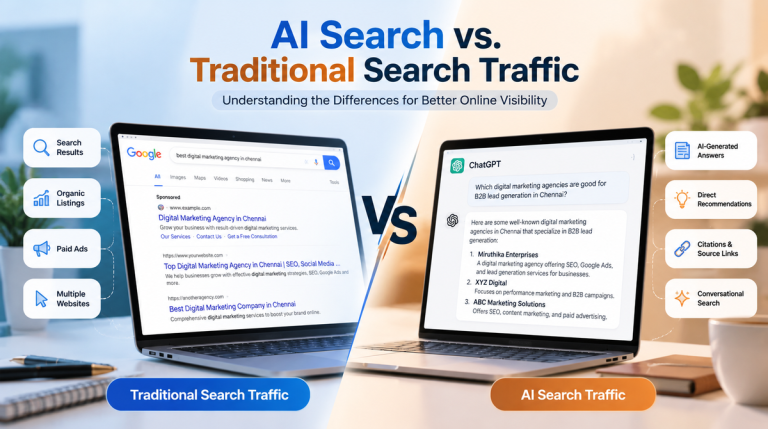
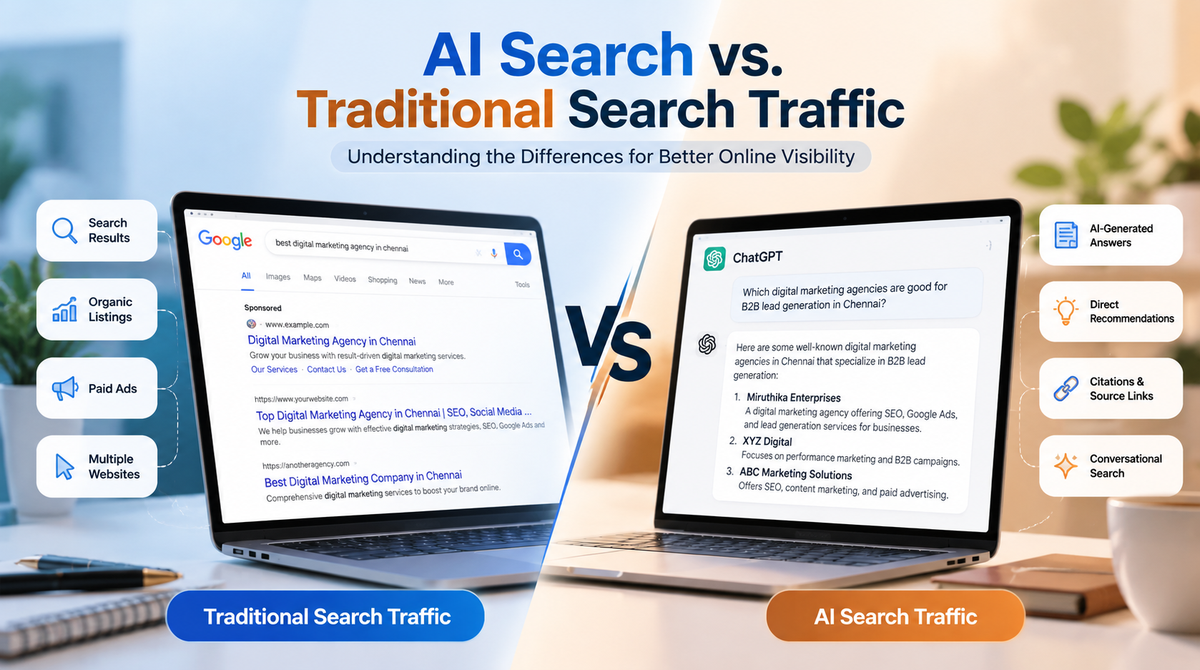
AI Search vs Traditional Search Traffic is becoming an important topic for businesses looking to improve their online visibility and attract potential customers. Traditional search engines like Google help users discover websites through organic rankings and paid advertisements, while AI-powered platforms such as ChatGPT, Google AI Overviews, and Perplexity are changing how people find information, compare services, and make purchasing decisions.
Understanding the differences between these search methods can help businesses build an effective digital marketing strategy, increase brand visibility, and attract relevant website traffic.
The answer lies in understanding how these two search approaches work and how they influence website traffic, brand visibility, and customer acquisition.
What Is Traditional Search Traffic?
Traditional search traffic refers to visitors who reach a website through conventional search engine results pages (SERPs). When users enter a query into Google or Bing, they typically see a combination of paid advertisements, organic listings, local results, and other search features.
Businesses optimize their websites to appear prominently in these results through Search Engine Optimization (SEO).
How Traditional Search Generates Traffic
Traditional search traffic is commonly driven by:
- Keyword optimization: Targeting relevant search terms used by potential customers.
- Organic rankings: Improving website content, technical SEO, and authority to rank higher.
- Paid search campaigns: Using platforms such as Google Ads to reach users actively searching for products or services.
- Technical SEO: Improving website speed, crawlability, indexing, and mobile usability.
- Content marketing: Publishing useful blogs, service pages, and resources that answer user queries.
For example, someone searching for “best digital marketing agency in Chennai” may visit several websites listed in Google’s organic results before choosing a service provider.
Traditional search often gives users multiple destinations to explore, making website clicks an important source of traffic and potential leads.
What Is AI Search Traffic?
AI search traffic refers to website visits generated when users discover and click links from AI-powered search experiences or conversational AI platforms.
Instead of simply displaying a list of links, these platforms can synthesize information from multiple sources and provide direct answers to user questions. Depending on the platform and query, they may also recommend businesses, cite websites, or provide links to relevant resources.
Examples include ChatGPT search, Google AI Overviews, and Perplexity.
How AI Search Influences Website Visibility
AI search visibility depends on several factors, including:
- Content relevance: Providing accurate, useful, and contextually relevant answers.
- Clear information structure: Organizing content with descriptive headings, concise explanations, and supporting details.
- Demonstrated expertise: Publishing original insights, practical examples, and trustworthy information.
- Brand authority: Building consistent brand information and credible references across relevant sources.
- Technical accessibility: Ensuring important content can be discovered and accessed by relevant search and AI systems.
For example, a user might ask an AI assistant, “Which digital marketing agencies help manufacturing companies generate B2B leads?”
An AI platform may recommend relevant agencies or cite useful pages, depending on its search capabilities and available information. A business that is mentioned or cited may gain visibility even if the user does not immediately visit its website.
This makes AI search an important channel for brand discovery, although not every AI mention produces a website click.
AI Search vs. Traditional Search Traffic: Key Differences
| Factor | Traditional Search | AI Search |
|---|---|---|
| User experience | Users browse search results | Users receive synthesized answers and recommendations |
| Discovery method | Rankings, snippets, ads, and local listings | AI-generated answers, citations, and recommendations |
| Traffic generation | Often driven by clicks on search results | May generate referral clicks, but can also provide visibility without a click |
| Content approach | Keyword relevance and search intent | Context, relevance, clarity, and comprehensive answers |
| Measurement | Organic sessions, rankings, CTR, and conversions | AI referrals, citations, brand mentions, and assisted conversions |
| Competition | Competing for rankings and search-result visibility | Competing to be included, cited, or recommended in AI answers |
| Optimization | SEO and paid search | SEO combined with AI search optimization and brand authority |
Both approaches help users discover information, but the way visibility translates into website visits can differ significantly.
Why Traditional Search Traffic Still Matters
Despite the growth of AI-powered discovery, traditional search remains an important channel for businesses.
1. High-Intent Website Visits
Users searching for specific services, prices, locations, or providers may be ready to take action. Relevant search results can bring potential customers directly to service pages, product pages, and contact forms.
2. Measurable SEO Performance
Traditional SEO offers established measurement methods, including impressions, clicks, click-through rate, keyword rankings, organic sessions, and conversions.
These metrics help marketers identify which pages attract visitors and contribute to business results.
3. Long-Term Organic Growth
Well-structured content, technically sound websites, and relevant backlinks can support sustained organic visibility. However, rankings and traffic are never guaranteed and require ongoing optimization.
Why AI Search Visibility Is Becoming Important
AI-powered discovery introduces additional opportunities for brands to become visible earlier in the customer journey.
1. Brand Exposure Beyond Website Clicks
A business may be mentioned in an AI-generated response even when the user does not click through to its website. This can create awareness that conventional website analytics may not fully capture.
2. Visibility During Complex Research
Users often ask AI platforms detailed questions involving comparisons, recommendations, and multiple requirements. Businesses with informative, relevant content may have opportunities to appear in these research journeys.
3. A New Layer of Digital Authority
Consistent information, useful expertise, credible third-party references, and clear service descriptions can help AI systems understand a business and its offerings.
However, there is no guaranteed method to make an AI platform mention a particular brand. Visibility depends on the platform, query, available sources, and other factors.
How to Optimize Your Website for Both AI Search and Traditional SEO
The most effective strategy is not to abandon SEO for AI optimization. Instead, build a search strategy that supports both discovery methods.
1. Create Content Around Real Customer Questions
Move beyond individual keywords and identify the questions your audience asks before making a purchase.
For example, an engineering consultancy could publish content addressing:
- What factors affect ethanol plant project feasibility?
- How does third-party inspection reduce quality risks?
- What should businesses evaluate before selecting an EPC consultant?
Answer each question with specific, accurate, and useful information.
2. Strengthen E-E-A-T Signals
Google uses the concepts of Experience, Expertise, Authoritativeness, and Trustworthiness as part of its approach to evaluating content quality.
Demonstrate these qualities through relevant project experience, expert authorship, accurate technical information, original case studies, and transparent business details.
These practices can improve content credibility, although they do not guarantee higher rankings or AI citations.
3. Improve Content Structure
Use descriptive H2 and H3 headings, short paragraphs, meaningful examples, and tables where appropriate.
Provide a direct answer near the beginning of each section, followed by supporting explanations. This helps readers navigate the page and makes its key information easier to understand.
4. Maintain Strong Technical SEO
Ensure that important pages are crawlable and indexable, internal links work correctly, mobile performance is strong, and canonical tags are implemented appropriately.
Use structured data where it accurately represents the content. Schema markup can help search engines interpret a page, but it does not guarantee AI inclusion.
5. Build Consistent Brand Authority
Keep your company name, services, contact details, and business descriptions consistent across your website and relevant business profiles.
Publish original research, practical guides, project insights, and expert commentary. Seek legitimate mentions and links from relevant industry websites rather than relying on artificial link-building tactics.
6. Track Both Traffic and Visibility
Use Google Search Console and Google Analytics to monitor traditional search performance. Where available, review referral traffic from AI platforms and track relevant conversions.
Also monitor brand mentions and citations across AI search experiences using a consistent set of industry-specific queries. Manual checks and third-party tools can help, but AI results may vary between queries, sessions, and platforms.
How to Measure AI Search and Traditional Search Performance
A complete measurement framework should distinguish between visibility, website traffic, and business outcomes.
For traditional search, monitor:
- Organic clicks and impressions.
- Search rankings and click-through rates.
- Organic landing-page sessions.
- Leads, purchases, and conversion rates.
For AI search, monitor:
- Referral sessions from identifiable AI platforms.
- Conversions from AI-referred visitors.
- Brand mentions and citations for relevant prompts.
- The quality and relevance of those mentions.
- Assisted conversions and changes in branded search demand, where measurable.
One important limitation is that AI visibility is harder to measure consistently than conventional search traffic. Some AI interactions generate no website visit, and analytics platforms may not identify every AI-influenced session.
For this reason, avoid judging AI search performance solely by referral traffic or treating every brand mention as a confirmed lead.
The Future: An Integrated Search Strategy
The distinction between AI search and traditional search is becoming less clear as conventional search engines integrate AI-generated answers and conversational experiences.
This means businesses should prepare for a search environment in which users may discover a brand through an organic listing, an AI-generated summary, a conversational recommendation, or a combination of these channels.
A practical strategy should include:
- Maintaining strong technical and on-page SEO.
- Creating people-first content that demonstrates genuine expertise.
- Answering specific customer questions with clear, reliable information.
- Building brand recognition across relevant digital channels.
- Measuring traffic, visibility, leads, and revenue together.
The objective is not simply to rank for more keywords or appear in more AI answers. It is to ensure that the right audience can discover your business, trust its expertise, and take the next step.
Conclusion
AI search and traditional search traffic serve different but increasingly connected roles in digital marketing. Traditional search provides established opportunities to attract visitors through rankings and paid listings, while AI search creates additional opportunities for brand discovery through synthesized answers, citations, and recommendations.
Businesses that invest in technically sound websites, credible content, strong brand authority, and meaningful performance measurement will be better positioned to adapt to these changes.
The real opportunity is to build a search strategy that earns both visibility and trust—wherever your potential customers look for answers.
Frequently Asked Questions (FAQs)
1. What is the main difference between AI search and traditional search?
Traditional search generally presents a list of results for users to explore, while AI search can synthesize information into direct answers and recommendations. Both can direct visitors to websites, but AI search may also create brand exposure without a click.
2. Is AI search replacing traditional SEO?
No. Traditional SEO remains important for organic visibility, website accessibility, and search performance. Businesses should strengthen their SEO foundations while adapting content and measurement practices to AI-powered discovery.
3. How can I increase my website’s visibility in AI search?
Publish accurate, helpful, well-structured content; demonstrate relevant expertise; maintain strong technical SEO; and build credible brand references. No tactic guarantees that a particular AI platform will cite or recommend your website.
4. Does AI search generate less website traffic?
AI-generated answers can satisfy some users without a click, which may reduce the need to visit multiple websites for certain queries. However, traffic outcomes vary by platform, query, industry, and user intent.
5. How do I track AI search traffic?
Use analytics referral reports to identify visits from recognizable AI platforms, then measure engagement and conversions. Track AI mentions and citations separately because brand visibility does not always produce a measurable website session.
6. Should businesses invest in AI SEO or traditional SEO first?
Start with a technically healthy website, strong foundational SEO, and useful content aligned with customer needs. Then extend that foundation with AI search visibility monitoring and content improvements suited to conversational discovery.
About the Author